
Darts,
explained
simply.
Everything a new player needs before the first throw: the board, the two games you'll play most, how a leg ends, and the words you'll hear at the line. Read it once, or keep it open on your phone next to the machine.
Know your
board.
A standard board is 451 mm across and split into 20 numbered segments. The number on the outer ring tells you what each segment is worth.
The thin outer ring is the double: twice the number. The thin inner ring is the treble: three times. The red centre is the bull, worth 50, and the green ring around it is the outer bull, worth 25.
Stay behind the line while someone is throwing, and walk up to collect darts only when everyone has finished their turn.
- Double ring2 × the number
- Treble ring3 × the number
- Singlethe number itself
- Bull · outer bullred centre 50, counts as a double; green ring 25
- 1.73 m
- floor to the centre of the bull
- 2.37 m
- face of the board to the throw line
- 451 mm
- across the board, 20 at the top
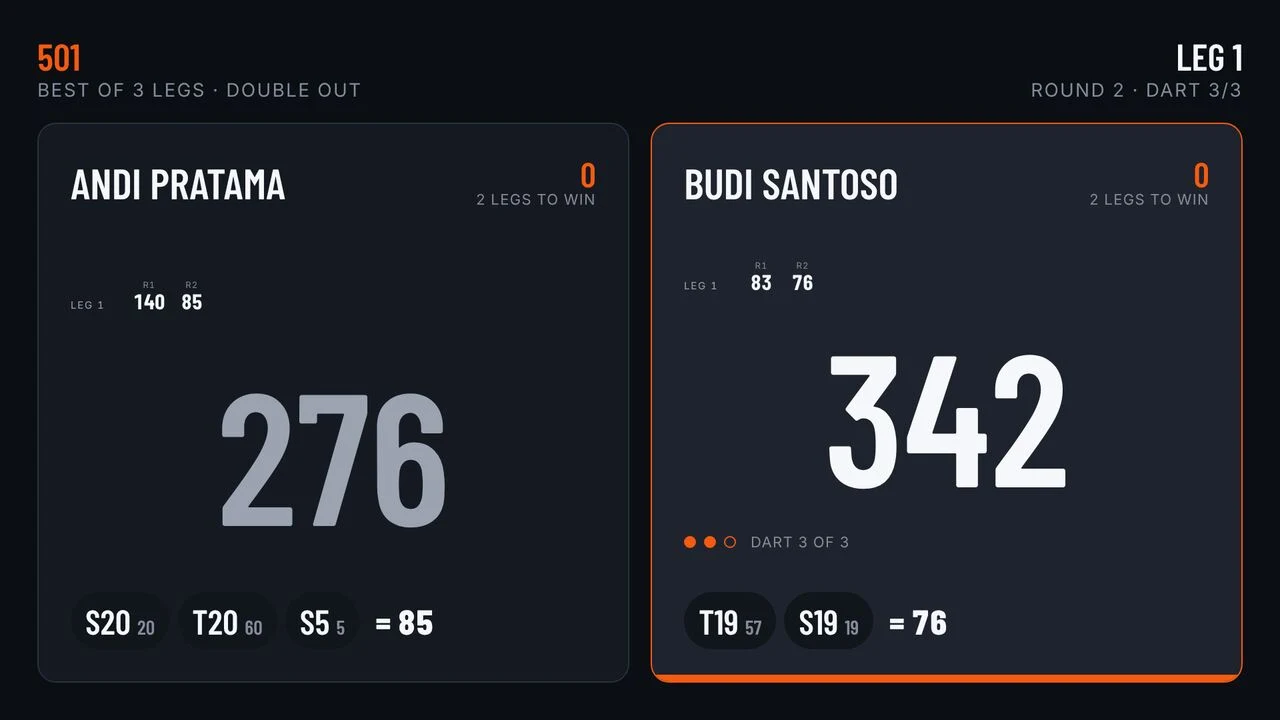
501: count down
to zero.
- Every player starts on 501.
- Take turns throwing three darts. Whatever you score comes off what you have left.
- Finish on a double that takes you exactly to zero. With 32 left, double 16 wins the leg.
- Score too much, or leave yourself on 1, and it's a bust: the turn doesn't count and your score goes back to where it was.
301 is a shorter leg and 701 a longer one, with the same rules. On the machine you never add anything up: the big screen counts you down and, when you can finish, shows the darts to aim for.
Cricket: close
the numbers.
- Only 15, 16, 17, 18, 19, 20 and the bull count.
- Hit a number three times to close it. A single counts once, a double twice and a treble three times. The outer bull counts once and the bull twice.
- Once you've closed a number, more hits on it score its value, as long as your opponent hasn't closed it too.
- Close everything with at least as many points as your opponent, and you win.
On the machine you can also play Cut-Throat, where your points go to your opponents and the lowest score wins, or Random numbers that stay hidden until someone hits them.
Finish on
a double.
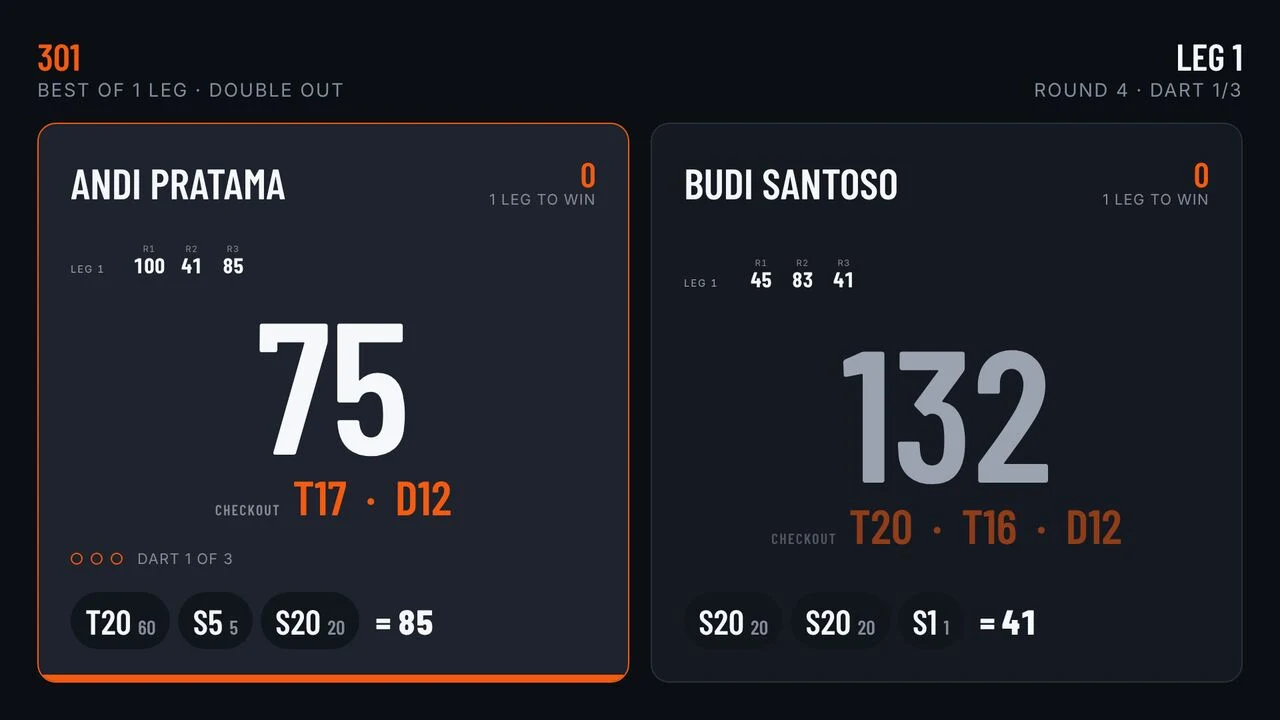
A leg of 501 ends on a double, or on the bull, which counts as one. It's the rule that makes the last few darts of a leg so tense. A few finishes worth knowing:
- 40D20The classic. Plenty of players aim to leave 40.
- 32D16Miss into single 16 and you're on 16, then 8, then 4: still a double every time.
- 41S9 · D16On an odd number? Hit a single first to leave yourself an even one.
- 100T20 · D20The most common two-dart finish from a ton.
- 170T20 · T20 · BullThe biggest finish in darts.
Some scores can't be finished in three darts: 169, 168, 166, 165, 163, 162 and 159. Players call them bogey numbers.
Real darts,
real board.
Dartsplay is played with steel-tip darts on a bristle board, the same set-up used in professional and club competitions around the world. The darts have weight to them, they stay where they land, and the board closes up around each hole.
Nothing on the board needs to be electronic. Cameras around it read every dart, so you keep the feel of the real game and still get automatic scoring, stats and a rating.
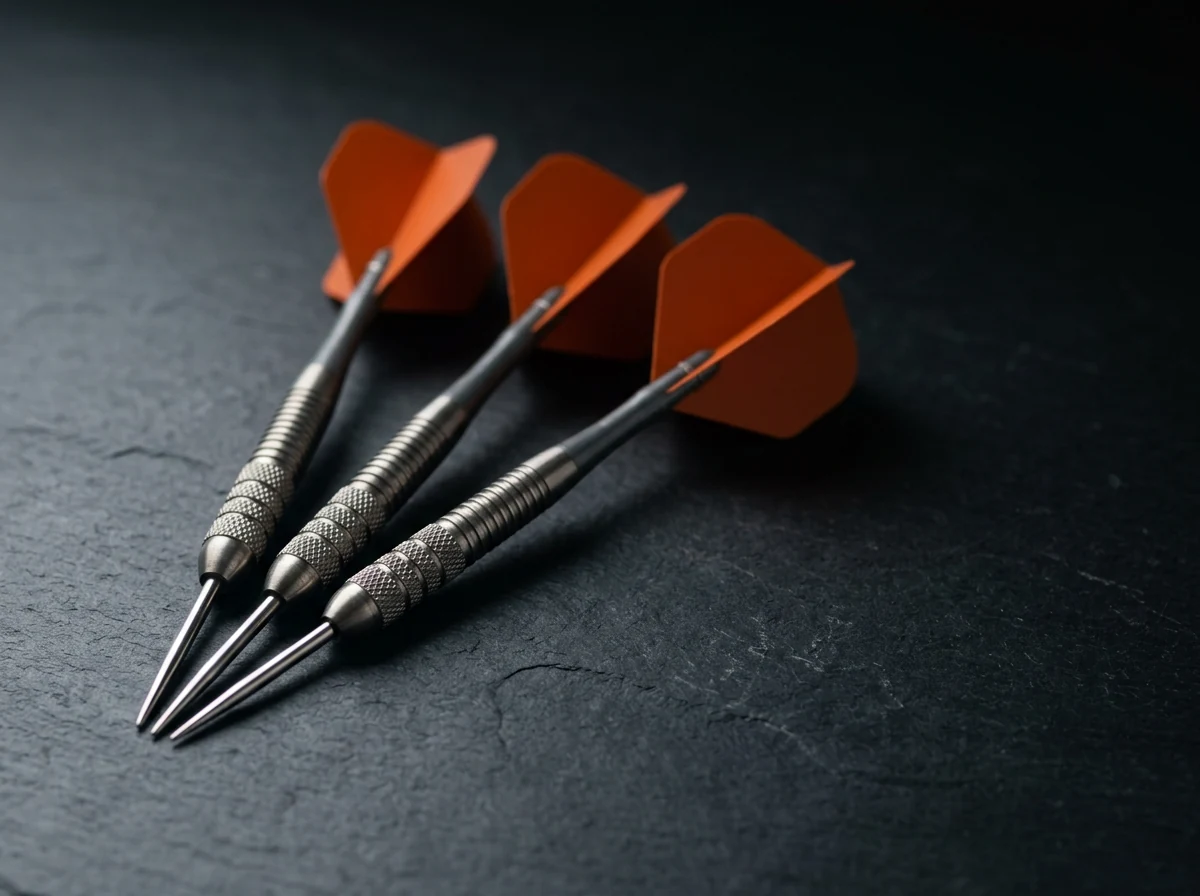
- Full-size board451 mm, hung at the official height
- Metal tipsthe same darts you'll find at any darts club
- Camera scoringthree cameras, so nobody types in a score
- Fixableif the cameras miss a dart, you correct it on the touch screen
More than 15
ways to play.
Pick a game on the machine's home screen. Play as a guest, or scan in with the app to keep your stats.
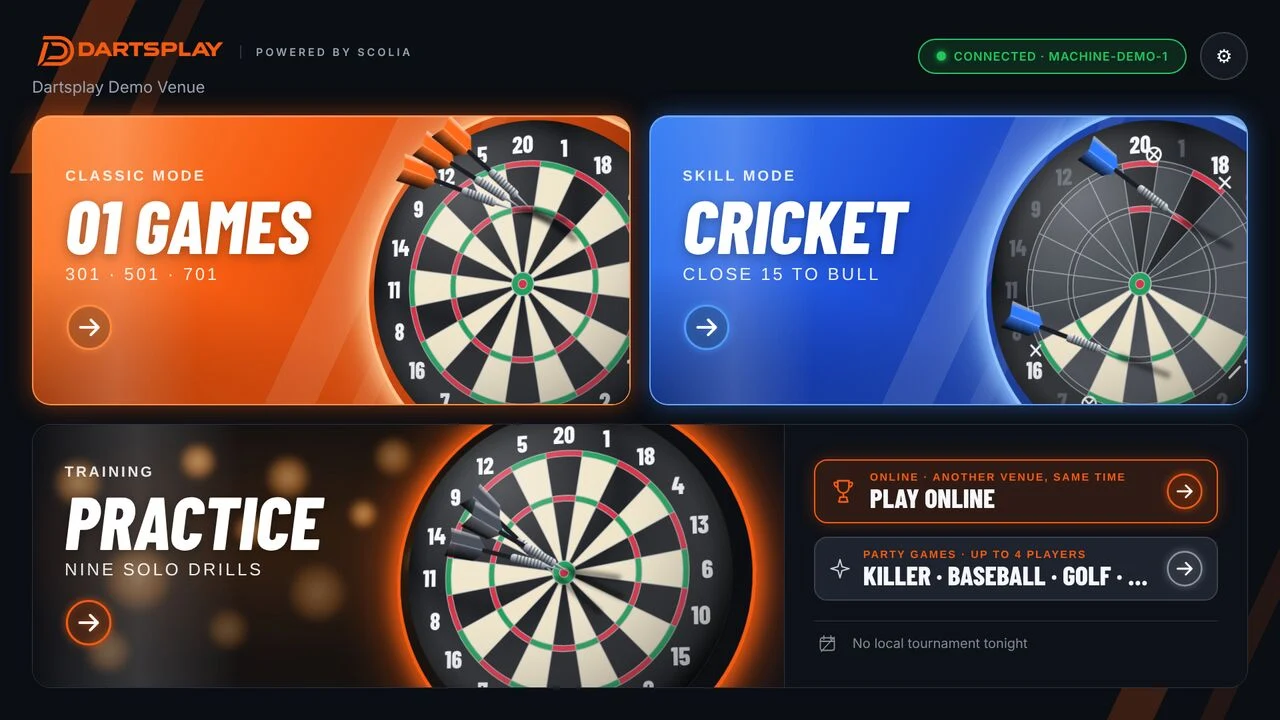
01 Games
301 · 501 · 701
The classic countdown, for 1 to 4 players or 2 against 2.
Cricket
Standard · Cut-Throat
Close 15 through 20 and the bull. Numbers can be 15 to 20 or random.
Practice
Nine solo drills + Skill Check
Around the Clock, Bob's 27, Halve It, Random Checkout, Doubles Training, Singles Training, 121 Climb, Count Up and Shanghai. Skill Check finds your weak spot: free once every 30 days, unlimited with Plus.
Party games
Up to 4 players
Killer, Baseball, Golf and Elimination. No maths needed, just good fun for a group.
Say it like
a player.
Darts has its own words. Terms stay in English, the way players use them.
Match
- Leg
- One game, from the starting score down to zero. First to finish wins the leg.
- Set
- A group of legs. Longer matches are played in sets.
- Visit
- One turn at the board: up to three darts.
- Oche
- The throw line you stand behind, 2.37 m from the board. Say it "ockey".
- Best of / First to
- Two ways to set the length of a match. Best of 5 legs means first to 3.
- Throw for bull
- Each player throws one dart at the bull; the closest starts the leg.
- Bust
- Scoring more than you have left, or leaving 1. The turn doesn't count.
Scoring
- Single
- The wide parts of a segment. Worth the number itself.
- Double
- The thin outer ring. Twice the number.
- Treble
- The thin inner ring. Three times the number.
- Ton
- A visit worth 100 or more.
- 180
- The best visit there is: three darts in treble 20.
- 3-dart average
- Points scored per visit, on average. The usual way to compare players.
- First 9
- Your average over the first nine darts of each leg.
The board
- Segment
- One of the 20 numbered slices.
- Bed
- One scoring area of a segment, such as treble 19.
- Bull
- The red centre, worth 50. It counts as a double.
- Outer bull
- The green ring around the bull, worth 25.
- Wire
- The thin metal frame that divides the board.
- Bounce-out
- A dart that falls out of the board. It scores nothing.
The dart
- Point
- The metal tip that goes into the board.
- Barrel
- The weighted part you hold.
- Shaft
- The stem between the barrel and the flight.
- Flight
- The wings at the back that keep the dart straight.
- Steel-tip
- Darts with metal points, thrown at a bristle board.
Finishing
- Double out
- A leg has to end on a double that takes you exactly to zero.
- Checkout
- The darts that finish a leg. The highest is 170.
- Setup
- A dart that leaves you a double you like, instead of going for the finish now.
- Bogey number
- A score you can't finish in three darts, such as 169.
- Madhouse
- Being left on double 1, the hardest place to finish.
- Nine-darter
- A leg of 501 won in nine darts, the fewest possible.
Big moments
- Hat Trick
- Three darts in the bull in one visit.
- 3 in a Bed
- Three darts in the same bed in one visit.
- White Horse
- In Cricket, three trebles on three different numbers in one visit.
- 9 Mark
- In Cricket, nine marks in one visit: three trebles.
- High Out
- A big checkout to win a leg.
On the machine
- Rating
- Your level, always shown with a number, like "Semi-Pro · 61.9". It comes from your 3-dart average over your last 30 rated matches.
- Levels
- Beginner, Amateur, Intermediate, Advanced, Semi-Pro, Pro and Elite.
- Form
- How your last 10 matches compare with your rating.
- Handicap
- A head start so players of different levels can have a close game. Free for everyone.
- Doubles
- Two against two, taking turns.
- Skill Check
- A short test that finds your weak spot.